
A simple method for writing complex plots
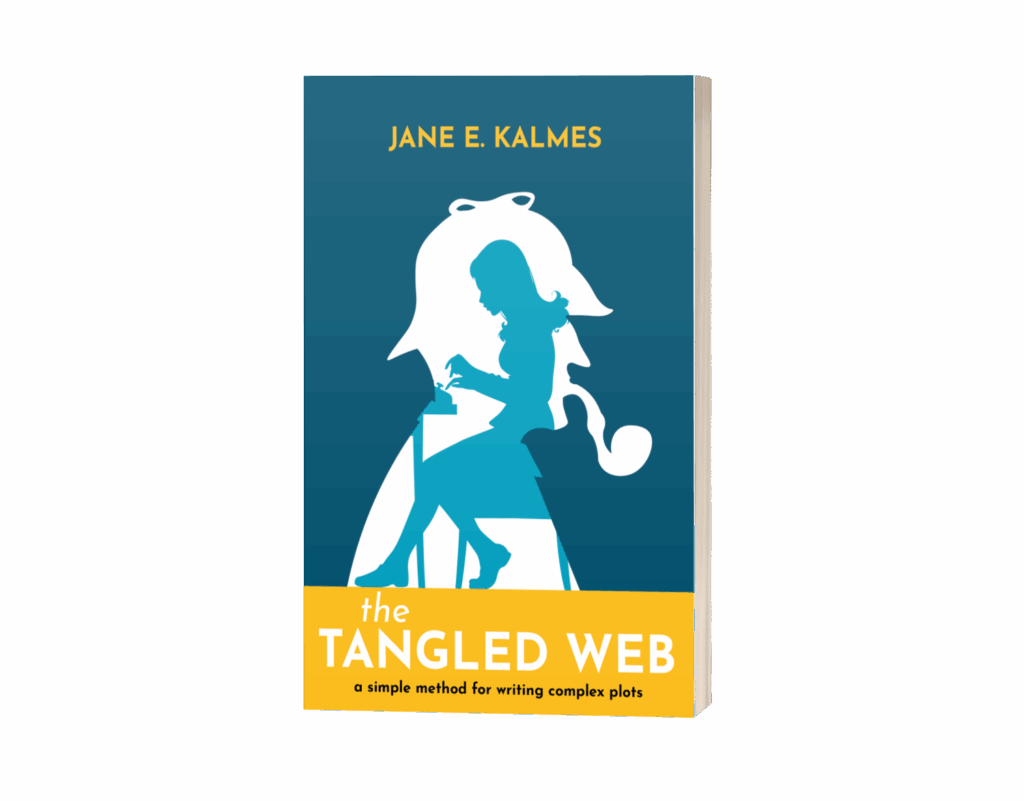
THE TANGLED WEB is the book I wish I had been able to read when I began writing mysteries. It will teach you how to:
- create an iconic sleuth
- construct plot twists that shock and satisfy
- brainstorm clues that will lead your sleuth to the solution
- hide those clues in plain sight
- distract the reader with false suspects
- enclose your mystery in a resonant story structure that allows your book to live in your reader’s heart
And so much more! Keep reading for an exclusive look at the first two chapters:
Introduction
YOU’VE GOT an idea.
An idea for a mystery. It’s been there, tickling the back of your brain, for a while now. Growing. Evolving. Sometimes when you’re walking the dog, or scrubbing the dishes, you find that you are not really living inside the sturdy walls of your home—or indeed, within the confines of your own life. You are living inside your idea.
But you want more than that. You want to invite others inside. And so you buy yourself a fresh ream of paper, brew a pot of coffee, and sit down at your computer. And for a while—a day, a week? Everything is perfect.
But then, you get stuck. You’re not sure how to proceed from your beginning to the glorious ending you envision. Even worse, doubts have begun to creep in. Is your idea tricky enough? Is it believable enough? Will it give people that magical feeling—the one you got when you were dreaming it up?
There’s no two ways abut it—you’re stuck. Youre caught in a tangled web of your own devising.
But you’re not alone. Most of the students who take my mystery writing workshops have come to exactly this place before they go looking for help. It turns out it’s very easy to get stuck writing mysteries. Why? Well…
Of all genres, mysteries place the most emphasis on a great final twist. It’s not enough to end your mystery by exposing a Villain whose guilt we can believe in. We need to be taken by surprise—to gasp in shock, then slowly start nodding along in dawning understanding.
Mysteries have a lot of moving parts. To build that understanding for your reader, you’ll need to lay out a network of clues—and none can be either too obvious or too subtle. You’ll also have to understand what your Villain is doing off screen throughout the novel, and build a collection of false suspects behind which to obscure his guilt.
Mysteries also have the problems of every other genre. In addition to being surprising and well-plotted, your mystery needs to be—well, a good book. Funny, perhaps, or poignant, or wise—but certainly, entertaining. And to produce it, you’ll need to spend a lot of hours alone with a blank page.
So, we know why we’ve got problems. What are we going to do about it? How can we tease apart the strands of our tangled web—while still leaving our reader snared in its mesh?
In this book, we’ll…
Examine the science behind plot twists. You’ll learn what a plot twist actually is—it may not be what you think! You’ll also learn the three methods for setting up plot twists, and how to reveal them for maximum effect.
Go deep on clues. You’ll come to understand the three different types of clues—Freebies, Lockboxes, and Whispers—as well as 12 specific tactics for hiding them.
Build a comprehensive vocabulary of mystery-writing terminology. You’ll fill your mental lexicon with terms like Action Log, Suspect Subplot, Incompetence Alibi, and Time-Shifting. Having this vocabulary in place will help you access—and deploy—these concepts while plotting.
Learn to build from the ground up. Here we arrive at the very crux of the Tangled Web system—a step-by-step method for creating a mystery. You’ll begin with a believable, primal motive, and layer on top of it every element that a good mystery needs—plot twists, clues, suspects, and more. The result of all this planning is what I like to think of as your mystery’s engine, because it’s what makes the whole thing work.
As with any brand new engine, building it will require some tinkering. That’s all right. I’ll be helping you to assemble a box full of simple tools, which you can use to get every gear tuned just right.
Along the way, we’ll learn why mysteries matter to people. We’ll discuss the primal questions of human nature that they allow us to scratch away at. And we’ll talk about how to wrap your engine in a solid story structure that will help your novel live in your reader’s heart.
All right—let’s get to building.
Chapter 1: Your Hook
ALL SET TO START building your mystery engine? Great! The first thing you’ll need is a workbench, a sturdy foundation upon which you can begin crafting your mystery. That workbench is your novel’s Hook—and choosing it will be one of the most important, and far-reaching, decisions you’ll make.
To see how important a Hook is, let’s imagine you walk into Barnes & Noble and wander over to the mystery shelves, looking for your next great read. You pick up a few, but nothing feels quite right. Then a cover catches your eye. You pick up the book, only halfway interested. But as you peruse the front cover, and then the back, you become more and more intrigued. Finally, you nod to yourself and head for the cashier.
What was it that sold you on this book? Most likely, it was the book’s Hook, the unique element that differentiated it from every other novel on the shelf. As a reader, the Hook is often the only thing you have to set a particular book apart from its competitors. You can’t judge the quality of the story yet, and you may know nothing of the author’s previous work. All you have to hang your decision on is the Hook.
Ok, great. A Hook is the thing that sets a book apart from the crowd. But what is it? And more importantly, how do you dream up a good one?
A Hook is simply this: the world your story inhabits. In Elizabeth Peters’ Amelia Peabody series, the Hook is Egypt. In Michael Connelly’s Lincoln Lawyer series, the Hook is the legal profession. In Charlaine Harris’ Southern Vampire series, the Hook is… well, vampires in the South. Each of these series dives deeply into the world of its Hook, taking readers on a tour of all its dark corners, exploring its eccentricities, and bringing its unique marvels to light.
Why do I consider the world of your story to be its Hook? Well, because the world does these two things for your novel:
• It can unite all the books in a series
• It can be conveyed clearly on the cover
The Hook can’t spark reader interest if it’s not visible on the cover. That’s why storylines and character dynamics—though they may be the most interesting parts of a book—are rarely viable as Hooks. In each of the Hooks I’ve mentioned above, readers quickly became more attached to the characters than to the world itself—and that’s how readers will probably engage with your novel as well. But it would have been hard for anyone to discover the delightful personality of Elizabeth Peters’ signature character, Amelia Peabody, if they hadn’t first seen a pyramid on the cover and thought, “Mystery about Egypt? Sounds interesting!”
There are four main types of Hooks that you might choose for your novel.
Time & Place Hooks
A Time & Place Hook inhabits the world of a particular time and place in history. These Hooks are used in historical novels that explore exciting time periods, such as World War II or the Roaring Twenties. But they’re also used in modern mysteries that take place in fascinating locales, like Hollywood, Ireland, or Hawaii.
Examples of Time & Place Hooks:
• Elizabeth Peters’ Amelia Peabody series (Victorian-era Egypt)
• Alexander McCall Smith’s No. 1 Ladies Detective Agency series (modern Botswana)
• Tana French’s Dublin Murder Squad series (modern Dublin)
Industry Hooks
Industry Hooks inhabit the world of the protagonist’s job, or perhaps her hobby. Cozy mysteries often use hobbies as their Industry Hook—there are lots of baking cozies, knitting cozies, you name it. Many police procedurals use the job of detective as their Hook, but you can also use a specific law enforcement job, such as a medical examiner or K-9 officer.
Examples of Industry Hooks:
• Michael Conelly’s Lincoln Lawyer series (legal profession)
• Diane Mott Davidson’s Goldy Bear series (catering profession)
• Maggie Sefton’s Knitting Mystery series (knitting hobby)
Invented Hooks
Invented Hooks are based on a world of the author’s own invention, such as a world of vampires or a world of witches. Paranormal mysteries use Invented Hooks, and so do mysteries that take place in a futuristic world.
Examples of Invented Hooks:
• Charlaine Harris’ Southern Vampire series (vampires)
• Victoria Laurie’s Ghost Hunter series (ghosts)
• Heather Blake’s Wishcraft mysteries (witches)
Character Hooks
Character Hooks are based on a protagonist with an extremely unusual personality trait, like Jeff Lindsay’s Dexter series, which is based on a character with psychopathic desires. Character Hooks are less common than the other three types, mostly because they’re harder to get across on the cover. Remember, a Hook needs to spark the reader’s initial interest—and that can only happen if the reader can understand it, right there in the bookstore.
Character Hooks are a little more common on television, but that’s because the network can use commercials to get across a strong sense of who the character is. For a novelist, the only commercial you are likely to have is the cover of your book!
Literary examples of Character Hooks:
• Jeff Lindsay’s Dexter series (psychopath)
• Dan Wells’ John Wayne Cleaver series (also a psychopath)
Television examples of Character Hooks:
• Monk (Obsessive Compulsive Disorder)
• House (breathtaking rudeness)
Double Hooks—and More
Let’s say you want to write a book that’s set in 1800’s Louisiana, in which a doctor solves mysteries with the help of his talking cat. That’s a Time & Place Hook, and Industry Hook, and an Invented Hook all rolled into one—can you do that?
Yes, absolutely, and many successful series do have complicated Hooks, just like this one. But you should still pick one Hook to be your Sales Hook, the Hook that your cover will concentrate on clearly conveying. In most cases, you’ll want to choose the most unusual of your hook points as your Sales Hook—so, probably that talking cat.
How do you come up with a good Hook?
There are two things you need to write within a particular world: knowledge about that world, and a passion for it. Of these, passion is the more important, because passion can lead you to develop knowledge, but the reverse is not always true. If you know a lot about the world of investment banking, but you’re not yet passionate about it, chances are low that you’ll develop a passion that will sustain you through an entire series, or even one novel.
To choose your Hook, jot down two lists: worlds with which you are very familiar, and worlds about which you hold a great passion. My lists might look something like this:
Knowledgeable:
• Motherhood
• Texas
• Catholic high school
•. The Roaring 20’s
• Video game industry
•. Collectible card games
Passionate
• Knitting
• Homeschooling
• World War II
• Early Christian church
• Dragons
• Writing & publishing
Now, take a look at your lists and circle the Hook that appeals most to you. Can’t decide? Well, welcome to my world! In the next chapter, I’ll show you a way to test drive your Hooks, so you can get a sense of what it will actually be like to work with each one. This exercise is also the first step you’ll want to take when you begin developing a new Hook, to make sure you find all the fun little bits of magic that can make your Hook come alive for your readers. We’re going to be creating your Image Bank.